Wooden log stores — pressure-treated softwood that actually lasts
Most log stores are wooden and there's a good reason: wood looks at home in a garden, doesn't conduct heat (so logs at the back don't sweat), and is easy to repair or replace components. The catch is maintenance — and the gap between a properly-treated log store and a cheaply-treated one is the difference between 12 years and 3.
This collection is filtered for log stores meeting BS 8417 Use Class 3 — the British Standard for timber used outdoors. Cheaper alternatives marketed as "treated" without specifying the class are routinely Class 1 (interior dry use only) and rot fast.
BS 8417 Use Class 3 explained
British Standard 8417 covers timber preservation. Use Class 3 specifies treatment for timber used outdoors above ground, exposed to weather. The treatment penetrates the wood to a controlled depth, with controlled retention of preservative. Timber meeting Use Class 3 has a 15+ year service-life expectation outdoors.
The cheaper alternatives:
- Use Class 1 — interior dry. Routinely sold as "treated" outdoor furniture; rots in 2–4 years outside.
- Use Class 2 — interior occasionally damp. Better than Class 1, still inadequate for log stores in UK weather.
- "Tantalised" — usually Class 3 but verify with the supplier.
- "Pressure-treated" — vague; could be any class. Insist on the BS 8417 class specifically.
What makes a log store actually season firewood
Logs need air circulation to dry. The principle:
- Open or louvred sides for airflow — not solid panels
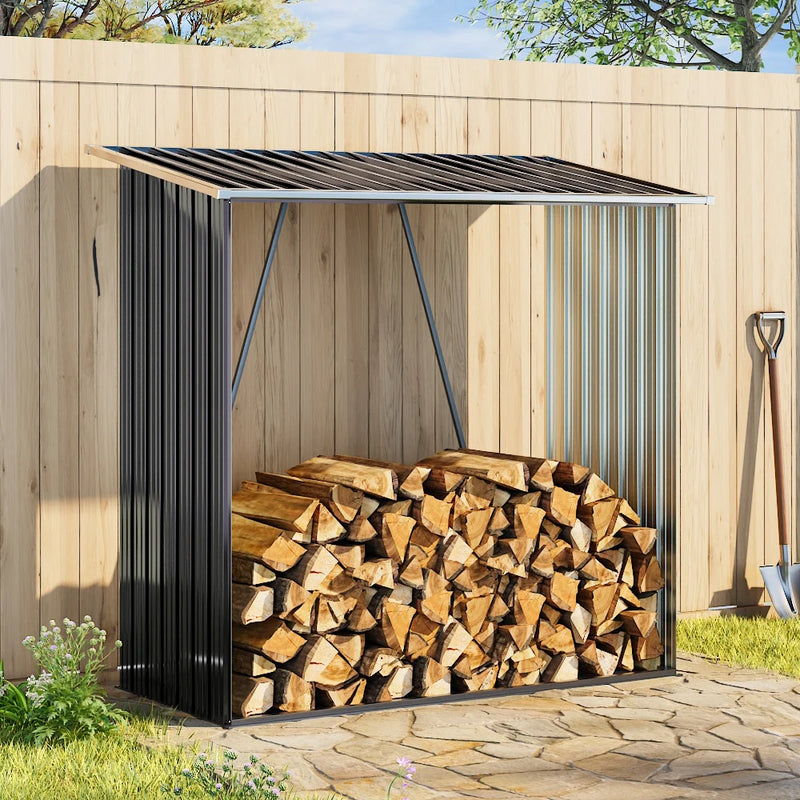
- Sloped roof, overhanging eaves — sheds rain off without splashback
- Raised floor / bearers — keeps logs off ground moisture (5–10cm clearance)
- Open back, or back with vents — allows through-airflow rather than trapped humidity
A log store missing any of these is mostly decorative. Cheap "log stores" with solid sides and no airflow keep wet logs wet — they don't season anything.
Capacity ranges
| Capacity | Annual use | Profile |
|---|---|---|
| 0.3–0.6 m³ | 10–25 fires/year | Compact wall-mounted |
| 0.8–1.2 m³ | 50+ fires/year | Standard freestanding |
| 1.5–2.5 m³ | Daily winter use | Larger or dual-bay |
| 3.0+ m³ | Primary heat source | Wood shed scale |
One bulk-bag of seasoned firewood is roughly 1.2 m³ loose, ~0.85 m³ when stacked. A 1 m³ store holds approximately one bag of stacked wood.
Pressure-treated softwood vs hardwood
Pressure-treated softwood (pine, spruce) is the standard. Affordable, structurally adequate for a log store, lasts 12–15 years with annual treatment top-ups.
Hardwood log stores (oak, larch) are far more expensive and last 20+ years without much maintenance. Aesthetic choice rather than necessity. Can age to a beautiful silver patina.
Untreated softwood has no business being outdoors in the UK. Don't be tempted by cheap "natural finish" stores; they'll fall apart fast.
Maintenance schedule
Pressure-treated softwood log stores need:
- Annual: visual inspection. Check bearers (the bottom rail) — they take the worst moisture. Brush off mould or moss with mild detergent.
- Every 2–3 years: re-treat with shed/garden grade preservative. Look for products labelled BS 8417 Use Class 3 compatible. ~£15–25 of product per coat.
- Every 5 years: closely inspect bearers and floor for soft spots. Replace if needed — these are the parts that fail first.
Hardwood stores need cleaning only — optional oiling every 3 years to maintain the original colour.
Where to put a log store
Two competing priorities:
- Close to the fire — you'll carry logs from October to April. Closer is better.
- In a windy spot — logs season in airflow. A sheltered corner is the worst spot for actually drying wood.
Compromise: south or east-facing wall, within 5–10m of the back door. Avoid: against fences (no airflow at the back), under trees (drips, leaf debris).
Stacking the wood properly
How you stack the wood matters for drying time:
- Bark side up — bark sheds water, cut faces absorb
- Cross-stack ends — alternate perpendicular pieces at each layer end for stability and airflow
- Leave 5–10cm at the back — air circulation behind the woodpile
- Don't stack to the roof — gap below the roof prevents water pooling on the top layer
Buying logs to fill it
UK Ready to Burn certification (mandatory under 2 m³ since 2021) means logs sold are under 20% moisture content — burnable. Below 15% burns hotter and cleaner. If your store has good airflow, even Ready to Burn logs continue to dry over the season — better fires by mid-winter.
Delivery
Wooden log stores ship from UK warehouse, free over £100, 5–7 working days. Smaller units courier; larger pallet-direct. Assembly takes 30–90 minutes depending on size — basic hand tools, two people for larger stores.
For broader buying advice see our complete log stores guide.