


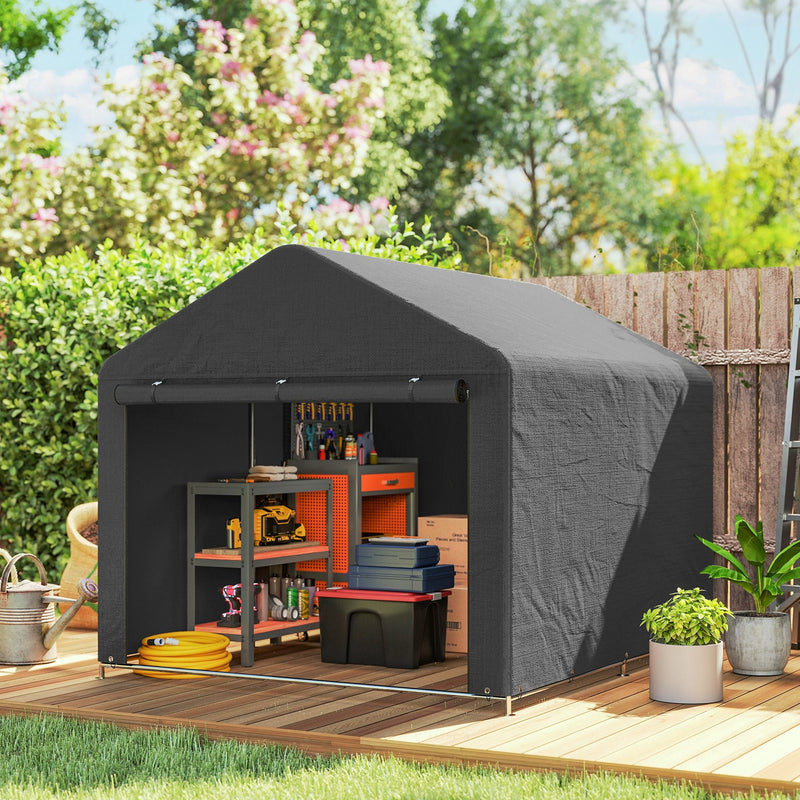
Metal sheds — galvanised steel for security and longevity
If you want the longest-lived, most secure shed for the money, metal is the answer. A properly galvanised steel shed lasts 20+ years with zero maintenance and resists casual theft far better than plastic or wood.
This collection is filtered specifically for hot-dip galvanised steel construction — the spec that delivers proper longevity, not the powder-coated-only steel that rusts at scratches within five years.
Hot-dip galvanised matters here especially
Sheds are made of large flat steel panels. The panels see weather constantly and bumps regularly. Hot-dip galvanising bonds zinc into the steel surface, providing barrier and sacrificial protection. A scratched panel keeps protecting itself.
Powder-coated-only sheds (no galvanising) start rusting at every scratch. Within 5 years it's structural. Within 8, the shed needs replacing.
The retail price difference between hot-dip and powder-coated-only is typically £150–300. The lifecycle difference is dramatic — one quality shed vs three cheap ones.
Where metal sheds win
- Security — actual barrier to forced entry. Ratings often Sold Secure compatible.
- Insurance compliance — for e-bikes, ride-on mowers, expensive tools, insurance schedules often require metal storage.
- Fire resistance — relevant for storing fuel cans, BBQ charcoal, anything that might spark.
- Vermin — rats can chew through wood and plastic. Not metal.
- Longevity — 20+ years routine.
Where metal sheds lose
- Aesthetics — utilitarian look. Fine for an industrial / allotment / utility location, less ideal for a feature spot in the garden.
- Heat — interior heats up significantly in summer sun. Don't store heat-sensitive items.
- Condensation — overnight cooling generates moisture inside sealed metal sheds. Vented designs solve it.
- Modification — drilling holes for hooks/shelves voids the galvanised coating at the puncture point.
Sizing
Metal sheds in the catalogue range from 4×3 ft (compact tool storage) to 12×10 ft (workshop scale). The sweet spot for most UK households is 6×4 to 8×6 ft.
Note: metal sheds use the same imperial sizing convention as wooden sheds, but the internal usable space is slightly tighter (thinner walls but no internal bracing).
Pent vs apex roof
Metal sheds come with two roof styles:
- Pent — single slope. Sheds water more efficiently in heavy UK rain. Looks more modern.
- Apex — peaked. More headroom in the middle. More traditional shed look.
For exposed locations in the UK, pent roofs are practical — water flows off in one direction, no central ridge to leak. Apex looks more like a "shed" if that matters aesthetically.
Doors and locking
Metal shed doors come in single or double configurations. Sliding doors are common and save space (no swing arc); hinged doors close more securely. For security:
- Internal hinges or carriage bolt fixings — external hinge pins can be popped
- Padlock receiver sized for a Sold Secure-rated padlock
- Anti-jemmy door edges — overlapping flanges that resist crowbar attacks
The hasp matters more than the lock. Cheap hasps fail the moment serious force is applied; quality hasps make the lock the weak point.
Ventilation
All metal sheds need ventilation. Without it, condensation forms inside overnight, drips on tools, and rusts anything ferrous. Look for:
- Eaves vents (under the roof line)
- Gable vents (at the apex on apex roofs)
- Floor-level mesh-protected airflow
Don't seal vents up "to keep dust out". You'll trade dust for rust.
Base requirements
Metal sheds bolt to the base. Three options:
- Concrete slab — anchors directly into concrete via expansion bolts. Most secure.
- Paving flags + bolted timber base — paving flags supply the level surface; bolt the shed to a treated timber perimeter
- Concrete pads + timber base — timber base bolted to set concrete piers; level adjusted at the timber level
Don't put a metal shed directly on grass. The base will bend, doors won't close, and condensation underneath will rust the floor panels.
Earthing — yes, really
Metal sheds in lightning-prone locations should be earthed. UK lightning strikes are rare but real, and a metal shed is essentially an above-ground rod. A copper earthing rod driven into the ground and bolted to the shed wall is sufficient. Talk to a qualified electrician for installations that include any electrical work inside.
Delivery and assembly
Metal sheds are heavy — typically 80–150kg empty for 6×4 ft, 200kg+ for larger. Pallet-delivered to UK mainland addresses, free over £100. Plan for two people on delivery and three for the larger units.
Assembly takes 4–6 hours for 6×4 ft with two people; 6–10 hours for larger. The galvanised panels can be sharp at edges; wear gloves. Manufacturer-quoted times are often optimistic for metal — add 30%.
For other materials see plastic sheds (zero-maintenance) and our complete shed range.